B1+ — Lesson 4

Education, Academic Life & Past Perfect

School & University · Past Perfect Form & Use · Sequence of Events · Mixed Tenses
← Back

Vocabulary: Education & Academic Life

B1+ Focus: These words and phrases elevate your vocabulary from basic "school" terms to discussing university, studying habits, and academic performance.

Academic Terms

Assignment/əˈsaɪn.mənt/Курсова работа / Задача
Curriculum/kəˈrɪk.jə.ləm/Учебна програма
Scholarship/ˈskɒl.ə.ʃɪp/Стипендия
Tuition fees/tjuːˈɪʃ.ən fiːz/Учебни такси
Degree/dɪˈɡriː/Академична степен / Диплома

Verbs of Studying

Revise (for an exam)/rɪˈvaɪz/Преговарям (за изпит)
Cram/kræm/Зубря (в последния момент)
Enroll (on a course)/ɪnˈrəʊl/Записвам се (в курс/университет)
Graduate/ˈɡrædʒ.u.eɪt/Завършвам образование

Phrasal Verbs (Education) B2 Level Up

Fall behind/fɔːl bɪˈhaɪnd/Изоставам (с материала)
Catch up (on)/kætʃ ʌp/Наваксвам
Hand in/hænd ɪn/Предавам (задача/домашнo)
Drop out (of)/drɒp aʊt/Прекъсвам/Напускам (училище)

Idioms for Students

Hit the books/hɪt ðə bʊks/Залягам над учебниците
Learn by heart/lɜːn baɪ hɑːt/Научавам наизуст
Pass with flying colours/pɑːs wɪð ˈflaɪ.ɪŋ ˈkʌl.əz/Вземам изпит с отличие
A teacher's pet/ə ˈtiː.tʃəz pet/Любимецът на учителя

Grammar Lab: The Past Perfect & Mixed Tenses
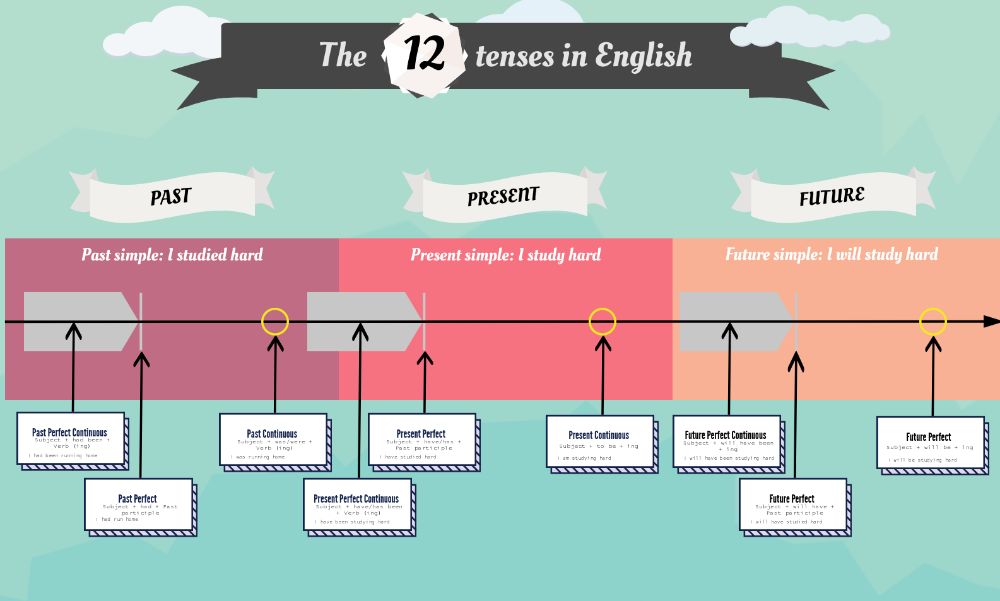
Education Timeline

Visualizing the "Past of the Past": The Past Perfect Timeline.

1. Structure: Past Perfect Simple

The Past Perfect Simple is formed using the auxiliary verb had and the Past Participle (V3 / -ed).

Affirmative (+)

  • Subject + had ('d) + V3 / -ed
  • I had worked hard.
  • She'd finished the exam.

Negative (-)

  • Subject + had not (hadn't) + V3 / -ed
  • We had not worked.
  • He hadn't finished.

Questions (?) & Short Answers

  • Had + Subject + V3 / -ed?
  • Had they worked?
  • Yes, they had.
  • No, she hadn't.
📝 Easy: Regular Verbs. Complete the sentences using the Past Perfect Simple (regular verbs only). Use contractions if you want.
1. (Fill the gap) I felt confident because I ___ (revise) all night.
2. (Negative) She ___ (not / complete) her assignment on time.
3. (Question) ___ you ___ (lock) the door before you left?
4. (Choose) They failed because they ___ to the teacher's instructions.
5. (Short Answer) Had he asked for help? No, he ___ .
6. (Fill the gap) The match ___ (start) before we arrived.
🎯 Hard: Irregular Verbs. Complete the sentences using the Past Perfect Simple. Watch out for irregular V3 forms!
1. (Fill the gap) I was hungry because someone ___ (eat) all the cake.
2. (Fill the gap) My phone didn't work because I ___ (break) the screen.
3. (Negative) We got lost because we ___ (not / take) a map.
4. (Rewrite) He went home. Then I arrived. → By the time I arrived, he ___ home.
5. (Choose) By the time they found him, the thief ___ away.
6. (Put the verb) She didn't know the answer because she ___ (forget) her book.

2. Use Cases: When do we use it?

A. The "Past of the Past"

  • The Visual Timeline: The Past Perfect is inherently relative. Do not process it as a single point in time, but rather as a "distance" from another past event.
  • We use it to make it clear that one action happened before another action in the past.
  • "When I arrived (Past Simple), the train had left (Past Perfect)."

B. Duration before a Past Moment (State Verbs)

  • We use it with for and since to show how long something had been true up to a point in the past.
  • Important: We use the Past Perfect Simple (NOT Continuous) with State Verbs (be, have, know, like).
  • "By the time he graduated, he had known his best friend for ten years."

C. The "Optional" Past Perfect (Nuance)

  • If the sequence of events is crystal clear because of words like before or after, the Past Perfect is sometimes optional—the Past Simple can do the job.
  • "After he finished (or had finished) his homework, he went out."
  • Rule: We must use Past Perfect when the sequence isn't obvious or when we want to emphasise that the first action was totally 100% completed.
📝 Easy: Basic Uses. Identify the first action or choose the correct basic form.
1. (Identify) "I ate dinner after I had cooked." Which action happened FIRST?
2. (Choose) I couldn't buy the ticket because I ___ my wallet.
3. (Put the verb) When we got to the cinema, the film ___ (already / start).
4. (Fill the gap) I ___ (not / study) Spanish before I moved to Madrid.
5. (Choose) She was very tired because she ___ hard all day.
🎯 Hard: Nuance & State Verbs. Decide between Past Simple and Past Perfect. Remember the rules for state verbs and sequences.
1. (State Verb) By 2010, they ___ (know) each other for five years.
2. (Sequence) I ___ (open) the door, walked inside, and ___ (see) the postman.
3. (State Verb) He ___ (have) that car for ten years when it finally broke down.
4. (Context) The street was incredibly wet because it ___ (rain) heavily the night before.
5. (State Verb) She ___ (be) a teacher since 2015 when she finally quit.

3. Signal Words for Past Perfect

These words help connect the two past actions and make the timeline clear.

  • Already / Just / Never: Placed between 'had' and the V3.
    "The class had already finished."
  • By the time / Before: Usually followed by the Past Simple action.
    "By the time I woke up, he had left."
  • After / Because: Usually followed by the Past Perfect action.
    "He passed because he had studied."
📝 Exercise: Signal Words. Select or type the correct signal word based on the meaning and sentence structure.
1. (Choose) The lesson had ___ started when I arrived, so I missed the introduction.
2. (Choose) ___ we got to the station, the train had left.
3. (Choose) He had ___ finished his lunch a minute ago when the phone rang.
4. (Fill gap) I had never seen a penguin ___ I went to the London Zoo.
5. (Fill gap) ___ she had handed in her essay, she felt completely relaxed.
6. (Fill gap) I had ___ seen such a beautiful beach in my entire life!

4. Past Perfect Continuous

Structure: Subject + had been + V-ing. At the B1+ level, you need to know the difference between "had worked" and "had been working".

Uses of Continuous

  • Focuses on the duration or effort of an ongoing action leading up to a past moment.
  • Used to explain a visible past result (e.g., being out of breath, dirty hands).
  • "He had been writing for hours, so his hand hurt." (Focus: Effort/Time).

Comparison: Simple vs Continuous

  • Simple: Focuses on the result or quantity (how many).
    "He had written three essays."
  • Continuous: Focuses on the process.
    "He had been writing all day."
  • 🚨 Reminder: Never use Continuous with State Verbs!
📝 Easy: Structure. Form the Past Perfect Continuous.
1. (Fill gap) They ___ (wait) for an hour before the bus finally arrived.
2. (Negative) She looked terrible because she ___ (not / sleep) well lately.
3. (Question) How long ___ you ___ (study) before you took the break?
4. (Choose) The ground was wet because it ___ raining.
5. (Fill gap) I ___ (work) in the garden all day, so my clothes were dirty.
🎯 Hard: Simple vs Continuous. Type the correct form (Past Perfect Simple OR Past Perfect Continuous). Think: Result vs Duration!
1. (Result) I was proud because I ___ (write) three essays by 5 PM.
2. (Duration) My hand hurt terribly because I ___ (write) all day.
3. (State verb) I trusted him completely because I ___ (know) him for years.
4. (Duration) She ___ (try) to fix the car for two hours before she finally called a mechanic.
5. (Result) He was energetic because he ___ (drink) four cups of coffee.
6. (Visible effort) They were out of breath because they ___ (run) to catch the train.

5. How to Write the Correct Tense

🧠 5 Questions to Ask Ourselves

Use this checklist when you see a blank space and aren't sure which tense to use.

1
Is there a "Time Stamp" word?
Look for: Yesterday, every day, since, currently, tomorrow.
→ If YES: The word dictates the tense. (e.g., "Yesterday" = Past Simple).
→ If NO: Move to Question 2.
2
Is this a "Forever Fact" or a "Temporary Snapshot"?
Look at: The nature of the statement.
→ Is it a habit or a scientific truth? (The sun rises; I drink coffee) → Use Present Simple.
→ Is it happening only in this specific moment? (I am drinking coffee) → Use Present Continuous.
3
Is the "Time Door" Closed or Open?
Look at: The relationship between the past and now.
→ Is it finished and disconnected from today? (I lived in Paris in 1990 — I don't live there now) → Use Past Simple.
→ Is it still true or does it still matter? (I have lived in Paris for 10 years — I still live there) → Use Present Perfect.
4
What are the "Neighbor Verbs" doing?
Look at: The sentences or clauses right next to the blank.
→ Are the other verbs in the Past? Then this blank is probably Past Simple (for a sequence) or Past Continuous (for a background description).
→ Are the other verbs in the Present? Then this blank is likely Present Simple or Future.
5
Can I actually "See" the action?
Look at: The type of verb (State vs. Action).
→ Is it a "thinking/feeling" verb? (Know, love, believe, want, understand) → Stop! You almost never use "-ing" with these. Even if it’s happening "now," use Present Simple.
→ Is it a "physical" verb? (Run, eat, shout, break) → You can use any tense.
📝 Easy: Basic Tenses. Apply the questions above! Choose from Present Continuous, Present Simple, Past Simple, Future Simple, or Going to.
1. (Q1: Time stamp) Yesterday, I ___ (visit) my grandmother in the hospital.
2. (Q2: Forever Fact) Water ___ (boil) at 100 degrees Celsius.
3. (Q2: Snapshot) Look over there! The baby ___ (walk) for the very first time!
4. (Intention) I bought this blue paint because I ___ (paint) my bedroom tomorrow.
5. (Sudden decision) "Oh, the phone is ringing!" "Don't worry, I ___ (answer) it!"
6. (Q1: Time stamp) She ___ (drink) two cups of coffee every single morning.
🎯 Hard: Advanced Mixed Tenses. Apply the 5 questions to all tenses, including Present/Past Perfect Simple & Continuous!
1. (Q3: Time Door) I ___ (live) in London for five years and I absolutely still love it here.
2. (Q4: Neighbor Verbs) I was walking down the street when I suddenly ___ (see) a terrible accident.
3. (Q5: Can I see it?) Even though I am confused, I ___ (know) the correct answer deep down right now.
4. (Past of the Past) When I finally got to the party, John ___ (already / leave).
5. (Present Perf Cont) You look absolutely exhausted! What ___ you ___ (do)?
6. (Past Perf Cont) The roads were completely flooded because it ___ (rain) non-stop for two days.
7. (Just) She ___ (just / finish) her homework, so she can finally go out with us now.

Reading: Academic Disasters & Successes

Read the texts carefully. Notice how the Past Perfect is used to establish what happened before the main past events.
😰

Text 1: The Nightmare Exam

Yesterday was the worst day of my academic life. I had a final exam for my History degree at 9:00 AM. I had set my alarm for 7:00 AM, but my phone battery had died during the night, so it didn't ring. I finally woke up at 8:45 AM. I threw on my clothes and ran to the university. By the time I arrived at the exam hall, the test had already started, and the doors were locked. I peered through the window and saw my classmates writing furiously. I felt terrible because I had hit the books all week and had even learned several dates by heart. When the professor finally let me in, fifteen minutes had passed. I sat down to write, only to realise that in my panic, I had forgotten to bring a pen! I eventually borrowed one, but I certainly didn't pass with flying colours.

Questions:

1. Why didn't the student's alarm ring?

2. What happened by the time he arrived at the hall?

3. How did he prepare for the exam beforehand?

4. What problem did he discover after sitting down?

🎓

Text 2: The School Reunion

Last weekend, I went to my high school reunion. I was most excited to see my old friend, Maya. In school, she had always been the teacher's pet. She had never fallen behind on her assignments and had always passed every exam with flying colours. When we finally spoke, I asked her about her degree. To my surprise, she told me that she had dropped out of university after just one year! She explained that she had realised the curriculum wasn't for her. Instead of studying, she had used her tuition fees to start her own tech company. Before she turned 25, her company had already made a million pounds. I was shocked. I had spent four years cramming for exams to get my degree, while the best student in our class had become a millionaire without one!

Questions:

1. What kind of student had Maya been in high school?

2. What did the author learn about Maya's university education?

3. What had Maya done with her tuition fees?

4. 🔍 Inference: How does the author feel about Maya's success compared to his own path?

Text 1 / 2

Cloze Text: Open Gaps

Read the story about an academic struggle. Type exactly ONE word into each numbered gap. Think about Past Perfect auxiliary verbs (had), signal words (already, before, after), and the lesson's vocabulary.

By the end of the first semester, Mark was in trouble. He (1) fallen completely behind on the university curriculum. The main problem was that he had (2) learned how to study independently before he enrolled on the course.

The day before his big essay was due, he realised he hadn't even started it! He (3) spent the whole month going to parties instead of hitting the (4). He decided to cram all night. By the time the sun came up, he had (5) finished typing the last paragraph.

He ran to the university to (6) in the assignment. However, when he arrived at the professor's office, the door was locked. He looked at the deadline notice on the wall. He was too late! The deadline (7) already passed. Because he (8) failed to submit the work on time, he lost his (9) and eventually had to drop (10) of the university entirely.

Key Word Transformation (KWT)

Complete the second sentence so that it has a similar meaning to the first, using the word given in capitals. Do not change the key word. Use between two and five words including the key word. Focus on Past Perfect and sequence of events.

Exercises & Drills

Fast-paced practice. Exercises 1-4 focus on the Past Perfect vs Past Simple. Exercises 5-10 will challenge you to mix and distinguish between Past Simple, Past Continuous, Present Perfect, and Past Perfect.

Mixed Tenses Writing (Ultimate Challenge)

Instructions: Read the context carefully. You must type the correct tense for the verb in brackets. These exercises mix all the tenses we have covered. Use contractions if you like!
🎯 Exercise 1: Mixed Tenses (1-10)
1. The film ___ (already / start) by the time we arrived at the cinema.
2. Shh! The baby ___ (sleep) in the next room right now.
3. William Shakespeare ___ (write) Romeo and Juliet hundreds of years ago.
4. I am completely exhausted today. I ___ (study) for five hours!
5. Look at those huge dark clouds! It ___ (rain) very soon.
6. I ___ (read) a book quietly when the phone suddenly rang.
7. Water ___ (boil) at 100 degrees Celsius.
8. I ___ (never / visit) Japan, but I want to go there one day.
9. The ground was wet this morning because it ___ (rain) all night.
10. I think humans ___ (live) on Mars in the distant future.
🎯 Exercise 2: Mixed Tenses (11-20)
1. She ___ (just / finish) her assignment, so she is free now.
2. We ___ (go) to Italy for our summer holidays last year.
3. "I'm cold." "Don't worry, I ___ (close) the window for you."
4. He ___ (not / do) his homework, so the teacher was very angry yesterday.
5. The train to London ___ (leave) at 8:00 AM every single day.
6. My eyes hurt yesterday because I ___ (stare) at the computer screen for hours.
7. You look tired! How long ___ (you / wait) here?
8. They ___ (play) football at exactly 5 PM yesterday.
9. I bought some flour yesterday because I ___ (bake) a cake tonight.
10. I normally walk to school, but today I ___ (take) the bus.
🎯 Exercise 3: Mixed Tenses (21-30)
1. I didn't recognise her at the party because she ___ (dye) her hair blonde.
2. Watch out! You ___ (drop) those glasses!
3. ___ (you / ever / eat) sushi in your entire life?
4. I ___ (see) an amazing documentary on TV last night.
5. He usually ___ (drink) coffee, but today he is drinking tea.
6. While I was cooking dinner, my brother ___ (watch) TV.
7. She ___ (learn) English for three years and she speaks it very well now.
8. Promise me you ___ (not / tell) anyone my secret!
9. Stop talking! The professor ___ (explain) the grammar rules right now.
10. They ___ (walk) in the mountains for hours before they finally found the cabin.
🎯 Exercise 4: Mixed Tenses (31-40)
1. What exact time ___ (you / arrive) in London yesterday?
2. I ___ (lose) my keys! I can't open the door now.
3. Before she moved to Paris, she ___ (never / learn) a single word of French.
4. Don't worry, I ___ (help) you carry those heavy bags.
5. Your clothes are covered in paint! What ___ (you / do)?
6. Yesterday morning, the sun ___ (shine) and the birds were singing.
7. We ___ (travel) to Spain next summer. We booked the tickets yesterday!
8. The Earth ___ (go) around the Sun.
9. Why ___ (you / cry)? Is everything okay right now?
10. I ___ (wait) for 40 minutes when the bus finally arrived yesterday.
🎯 Exercise 5: Mixed Tenses (41-50)
1. We ___ (have) a party next weekend. Do you want to come?
2. Christopher Columbus ___ (discover) America in 1492.
3. Oh no! I ___ (break) my favorite mug. Look at the pieces on the floor!
4. By the time I woke up, my parents ___ (already / leave) for work.
5. I ___ (study) medicine at university. That's my long-term life dream.
6. The boys were extremely tired yesterday because they ___ (play) football all morning.
7. He ___ (work) on this project since January, and he is almost done.
8. I ___ (have) a shower when you called me last night.
9. I never ___ (eat) breakfast on weekdays.
10. I think our team ___ (win) the championship this year.